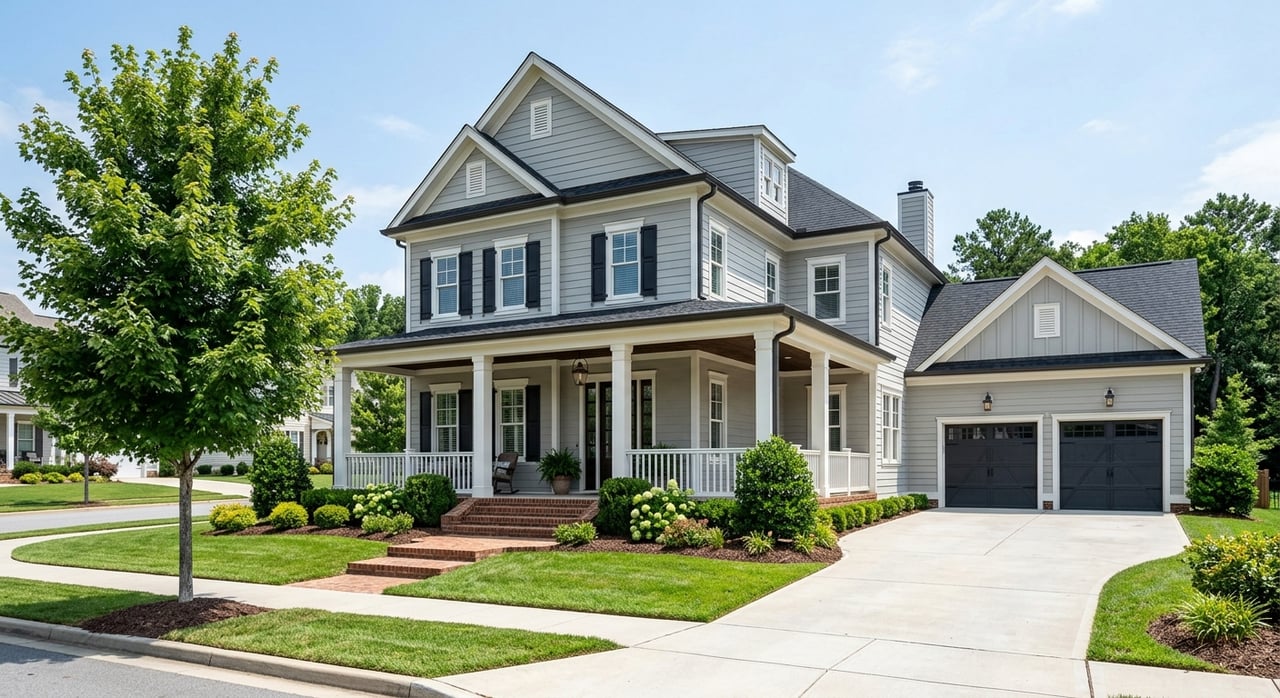
Your Guide to a Mooresville Move-Up Home Purchase
June 11, 2026
June 11, 2026
Thinking about moving up in Mooresville? You are not alone, and you are probably asking the same big questions most homeowners ask first: how much home can you really afford, when should you list, and how do you avoid getting stuck between two closings? If you already own a home, your next purchase can open the door to more space, a different layout, or a new neighborhood fit, but it takes careful planning. The good news is that Mooresville gives you options, and with the right strategy, you can move with more confidence. Let’s dive in.
Mooresville’s housing market is active, but it is not overloaded with inventory. In April 2026, Canopy MLS reported 478 homes for sale, 267 new listings, 120 closed sales, and 3.5 months of inventory. The median sales price was $477,500, with homes taking about 57 days on market until sale.
Zillow’s April 30, 2026 data shows a similar picture, with a typical home value of $483,732, a median list price of $520,000, 540 homes for sale, and 42 median days to pending. The numbers are not identical because the sources use different methods, but both point to a market centered in the upper-$400,000s to low-$500,000s. For you, that means there is enough inventory to compare homes, but not so much that strong listings sit around for long.
One of the biggest advantages in Mooresville is the range of price points within the market. Zillow neighborhood values run from about $225,882 in the Davie Avenue and Broad Street Historic District area to about $784,241 in Kings Crossing. Other areas, like Carriage Downs at $657,737 and Zemosa Acres at $595,528, sit above the townwide median.
That spread matters if you want to stay in Mooresville while changing your home style, size, or budget. You may be looking for a newer home, more square footage, a larger lot, or a different neighborhood setting. Mooresville gives you room to explore several tiers without necessarily leaving the area you already know.
A useful benchmark from NC REALTORS says six months of inventory is considered a balanced market. Mooresville was at 3.5 months in April 2026, which means it still leans somewhat toward sellers. In simple terms, buyers have more options than they did in tighter years, but well-priced homes can still attract attention.
That is especially important if you plan to sell one home and buy another at the same time. Your current home may benefit from a market with limited supply, while your next purchase may still require quick decision-making. If you are shopping in higher price ranges, inventory may be a little more favorable, since statewide data shows supply tends to rise in upper price bands.
Your home equity is often the foundation of a move-up plan, but it is not the whole story. Before you start touring homes, you need a clear idea of what your current home might sell for and how much you may net after paying off your mortgage and sale-related costs. That gives you a better picture of what funds may be available for your next purchase.
Just as important, lenders look beyond equity. According to the CFPB, they review your income, assets, employment, savings, debt payments, and credit history when deciding whether to lend. So even if you have built strong equity, you still need a full financial plan that supports the next monthly payment.
When you move up, the monthly payment is usually the number that gets the most attention. But the true cost of homeownership is broader than principal and interest. The CFPB recommends budgeting for property taxes, insurance, HOA fees, maintenance, utilities, and possible flood insurance, along with your mortgage payment.
You should also leave room for the costs that show up right after closing. Those can include moving expenses, repairs or updates, furnishings, and a cash cushion for unexpected issues. The CFPB suggests keeping an emergency reserve of about three to six months of expenses, which can help you feel more stable during a major move.
Closing costs are easy to underestimate in a move-up purchase. The CFPB says buyers typically pay about 2% to 5% of the home price in closing costs before the down payment. On a $500,000 home, that works out to roughly $10,000 to $25,000.
That number matters because many move-up buyers plan to use proceeds from their current home, but they still need enough liquid cash to get through the process smoothly. A larger down payment can reduce the loan amount and monthly payment, and putting 20% or more down on a conventional loan usually helps you avoid mortgage insurance. The key is making sure your plan works not just on paper, but in real life.
Property taxes should be part of your budget from the beginning because they can vary by parcel. For FY 2026 through 2027, Iredell County kept its county tax rate at 50 cents per $100 of valuation. The Town of Mooresville’s FY 2026 budget kept the town rate at $0.4836 per $100 of assessed valuation.
That creates a base combined local rate of 0.9836 per $100 for a home inside town limits, before any district add-ons. Using that base rate, annual local property taxes are about $4,918 on a $500,000 assessment and about $9,861 on a $1,002,580 assessment. Some parcels may also include Mooresville School or Mooresville Downtown taxing units, so it is smart to verify taxes on the exact property you want.
There is another reason to double-check. Iredell County notes that the next revaluation will be effective January 1, 2027. If you are planning a move-up purchase, reviewing the target parcel’s current tax details can help you avoid surprises.
The hardest part of a move-up purchase is often not finding the home. It is coordinating the sale of your current home with the purchase of your next one. The CFPB explains that closing is the last step in buying and financing a home, and that the loan closing and home-purchase closing typically happen at the same time.
That means you are managing more than one timeline at once. You have your listing timeline, your home search timeline, your contract timeline, and your move timeline. In a market like Mooresville, that process is measured in weeks and often months, not just a few days.
Recent Mooresville data gives helpful context for expectations. Zillow shows homes going pending in about 42 days, while Canopy MLS reported 57 days on market until sale and 66 cumulative days on market in April 2026. Once you add inspections, financing, negotiations, and closing, your overall move-up process can stretch across multiple months.
That is why early planning matters so much. If you wait until the last minute to sort out your financing, estimate your net proceeds, or define your purchase budget, the two sides of the transaction can start working against each other. A clear plan gives you more flexibility and fewer rushed decisions.
Even a modest jump in price can create a noticeable change in your monthly payment. Freddie Mac reported on June 4, 2026, that the average 30-year fixed mortgage rate was 6.48%. That is slightly lower than the previous week, but it still reflects a mid-6% rate environment.
For move-up buyers, that means the payment difference between your current home and your next home may be larger than expected. This is one reason pre-approval matters before you list. Knowing your payment ceiling early helps you search with confidence and avoid falling in love with a home that stretches your comfort zone.
A smart move-up strategy usually starts with clear numbers and realistic timing. You want to know what your current home may sell for, how much cash you may need, what monthly payment feels comfortable, and how property taxes and other expenses affect the full picture. Once those pieces are in place, your next steps become much easier.
Here is a simple framework to guide your planning:
This kind of plan gives you options. You may decide to stay near the town median, move into the upper-$500,000s or $700,000s, or search in a higher-end segment where supply may be somewhat more balanced. In every case, the goal is the same: make your next move with clarity, not guesswork.
Mooresville is not a one-size-fits-all market. The median sale price sits in the high-$400,000s, but the average list price in April 2026 reached $1,002,580, which shows a meaningful higher-end segment. That variety creates opportunity, but it also means your strategy should match the price range and timing of both your sale and your purchase.
If you are planning a move-up purchase, the strongest first step is getting organized before you make any sudden moves. When you understand your numbers, your timing, and your local options, you put yourself in a much stronger position to act when the right home appears. If you want help building a move-up plan that fits your goals, connect with Kelsie Blevins for a local, relationship-first approach.
Stay up to date on the latest real estate trends.
I am committed to guiding you every step of the way—whether you're buying a home, selling a property, or securing a mortgage. Whatever your needs, I've got you covered.
Kelsie Blevins
ADDRESS 785 US HIGHWAY 70 SW STE 100 HICKORY NC 28602