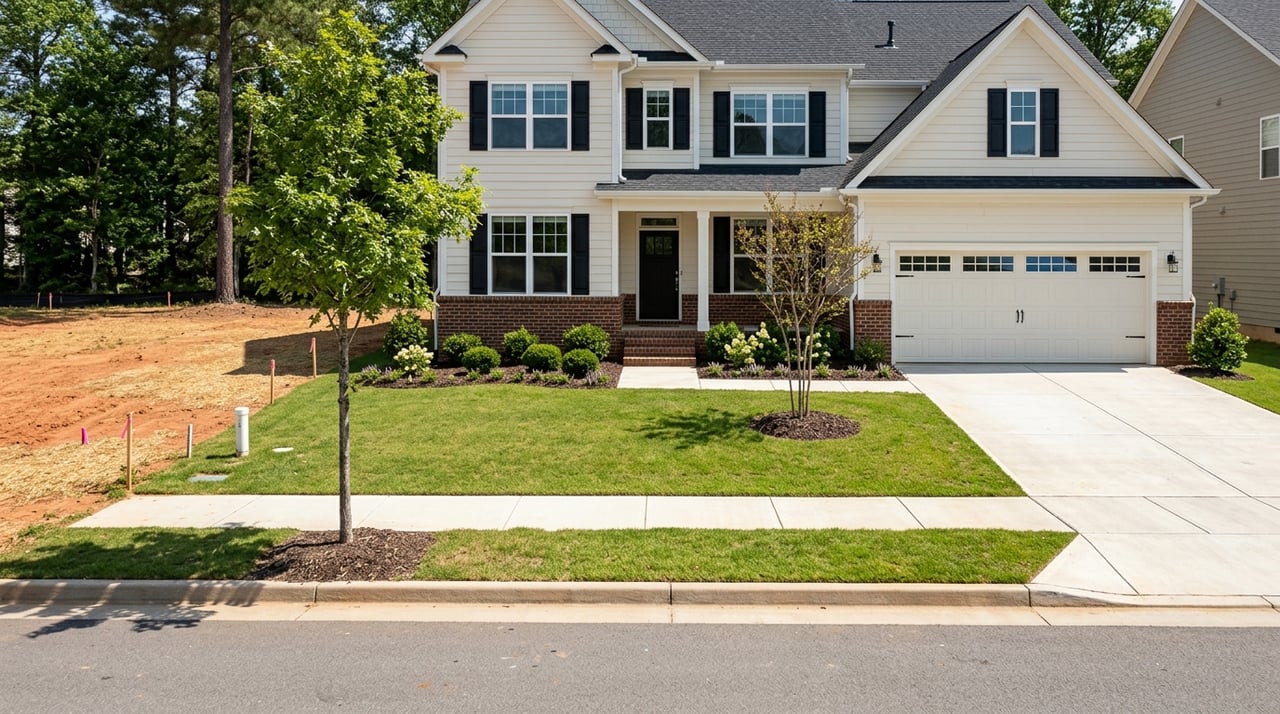
Building Or Buying In Anchors Landing
July 23, 2026
July 23, 2026
Wondering whether you should build or buy in Anchors Landing? If you love the idea of Lake Hickory living in Granite Falls, that decision can feel exciting and a little overwhelming at the same time. The good news is that both paths can work well, and the right choice usually comes down to your timeline, budget, and how much customization you want. Let’s dive in.
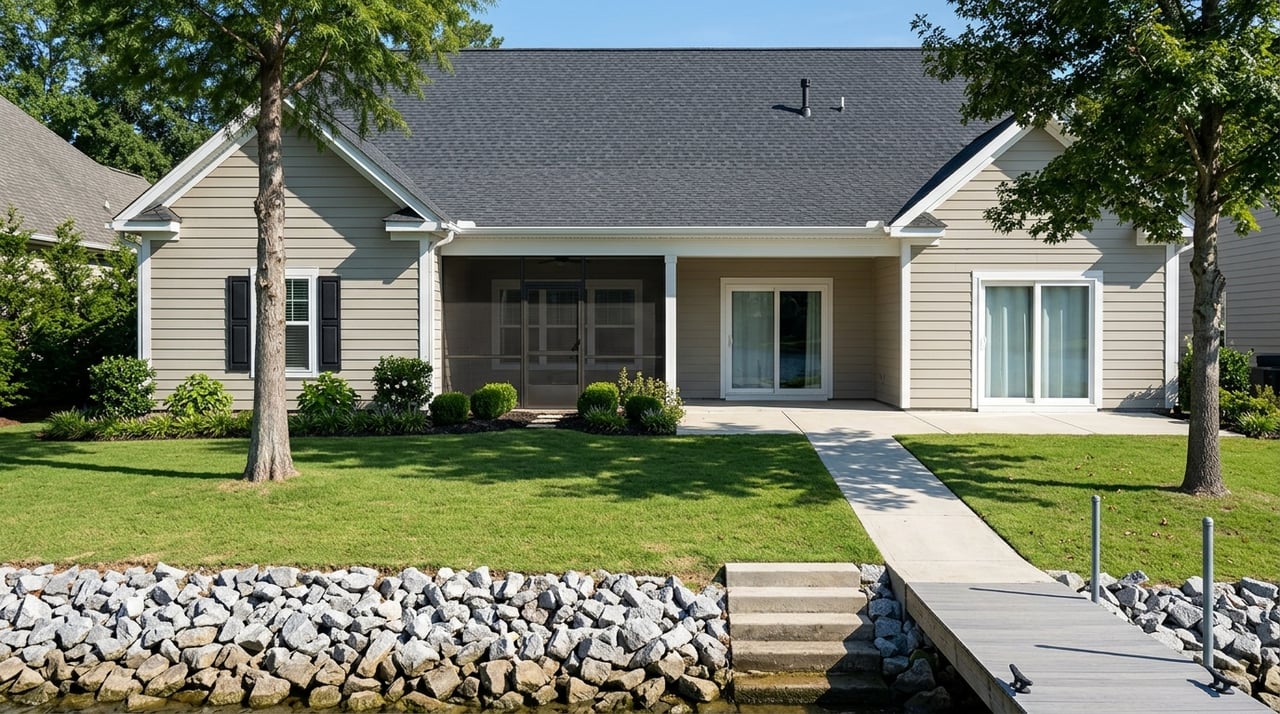
Anchors Landing is a gated community in Granite Falls on Lake Hickory with HOA-managed amenities. Current listing information points to features such as a clubhouse, pool, walking trails, lake access, boat storage, and boat slips. For many buyers, that mix of neighborhood amenities and lake-oriented living is a big part of the appeal.
The current market also shows a wide range of options. Existing and new-construction homes are listed from the mid-$700,000s to just under $900,000, while lots are listed from about $29,700 to $74,500. Lot sizes in current examples range from about 0.88 acres to 2.85 acres, which means your starting point can look very different depending on the property you choose.
Building gives you more control over the finished product. If you have a specific vision for your layout, finishes, or how the home sits on the lot, that can be a major advantage. Still, in Anchors Landing, that flexibility comes with important limits and added steps.
Not every lot supports the same kind of home design. Current listings describe wooded, sloped, and cul-de-sac homesites, with some parcels noted as better for a smaller home with a basement and others suited for a walk-out basement. That means the lot can directly influence your floor plan, driveway design, basement style, and site-work costs.
This is one of the biggest reasons building is not as simple as choosing a plan online. Two lots with similar list prices may require very different preparation and construction approaches. Before you commit, you want a clear picture of what the specific lot can realistically support.
Utility readiness is not the same from lot to lot. One current lot shows an approved septic permit already in place, while others still need septic and may have either city water or county water with a tap-fee requirement. One listing also notes no city taxes paid, which is another detail that should be verified on a parcel-by-parcel basis.
These differences matter because they can change both your timeline and your upfront costs. A lower-priced lot may still require added spending for septic approvals, water access, or other setup work. When you compare build options, it helps to look beyond the land price alone.
Building in Anchors Landing does not mean unlimited design freedom. Current lot restrictions reference architectural review, square-footage minimums, and rules against manufactured or modular homes, with one listing identifying the property as site-built only. In practical terms, you can personalize your home, but you still need to work within the community’s recorded rules and review process.
That makes early planning especially important. If you are thinking about a certain style, home size, or layout, you want to confirm that the lot and the review requirements line up before moving forward.
Caldwell County says septic lot evaluation must be approved before a septic improvement permit and authorization to construct are issued. The county also says that authorization is required before building permits can be obtained, and permits and inspections are required for new construction.
This matters because it adds steps before construction even begins. A build in Anchors Landing is usually a months-long process, not a quick move. If your timeline is flexible, that may be fine, but if you need to relocate soon, it can be a major factor.
Caldwell County’s fee schedule lists residential heated building permits at $0.45 per square foot, with a $75 minimum, plus separate zoning and trade permits. Using the county’s fee schedule, a 2,803-square-foot home would have about $1,261 in residential heated building-permit fees before adding the other permit categories.
That does not tell you the full cost of building, but it is a good reminder that land plus construction is only part of the budget. Permit fees, utility work, septic, and trade permits all need to be part of your planning.
Construction financing is often different from a standard mortgage. The research notes that construction loans usually advance funds in stages as work progresses and generally carry higher interest rates than a longer-term mortgage. It also notes that construction-to-permanent options may allow interim construction financing to transition into a permanent mortgage.
For buyers, that means the financing process can be more layered than buying a completed home. You may need more coordination between lender, builder, and project milestones. That is another reason many buyers benefit from a clear plan before purchasing a lot.
A useful benchmark from NAHB shows about 1.3 months from lot sale to construction start and about 6.3 months from start to completion for single-family homes built for sale in 2020. Those are national averages, not local guarantees, but they help set expectations. In Anchors Landing, septic approval and architectural review can sit ahead of construction, which can stretch the timeline further.
If you are building because you want control and customization, that longer timeline may be worth it. If speed matters most, this is often where buying an existing home starts to look more attractive.
Buying an existing home is usually the faster and more predictable path. Instead of managing land suitability, design choices, permits, and staged construction draws, you are evaluating a completed property that already exists. For many buyers, that simplicity is a real advantage.
Current inventory examples include an existing 4,672-square-foot home at 133 Greens Rd listed at $749,600 and another 3,939-square-foot home at 4975 Harbor View Dr W listed at $989,900. That gives buyers a chance to compare real homes, real layouts, and real move-in timelines instead of starting from the ground up.
Freddie Mac’s homebuying timeline says the closing phase can take 30 to 60 days, while the broader search-and-approval process is typically measured in weeks rather than months. Even with inspections, appraisal, underwriting, and closing costs, that is still materially faster than most ground-up builds.
If you need to move on a set schedule, buying can remove a lot of uncertainty. You know what is already built, and you can focus on condition, price, financing, and closing instead of construction management.
An existing home may also come with features that would be expensive or time-consuming to add later. A recent Anchors Landing sale at 145 Greens Rd included more than one acre, a private pool, a bonus room, and a heated-and-cooled basement workshop.
That is worth thinking about when you compare cost. A finished home may offer extras that would take significant time and money to recreate in a new build. Sometimes the better value is not the newer shell, but the complete package already in place.
The price tag is only part of the story in Anchors Landing. Whether you build or buy, ongoing ownership costs matter too. Looking at those numbers early can help you avoid surprises.
Using Caldwell County’s 2026-27 tax rate of 0.4666 per $100 of assessed value as a rough proxy only, county tax would be about $139 per year on a $29,700 lot, about $3,498 per year on a $749,600 home, and about $4,195 per year on an $899,000 home. Actual tax bills will depend on assessed value and any additional district taxes.
That makes a good reminder that holding a lot is not free just because the land price seems manageable. Taxes may be lower on land than on a finished home, but they still factor into your total carrying cost while you wait to build.
Current lot listings also show meaningful HOA costs. One lot is listed at $93 per month, while others show $1,115 annually and $1,288 annually. So even if you buy land first and plan to build later, there is still an ongoing cost to carry that property.
For some buyers, that is completely worth it to secure the right homesite. But it is important to budget for those costs while you work through design, approvals, and construction timing.
One current lot listing notes county water with a tap-fee requirement and no city taxes paid. That is a helpful reminder that lot pricing alone rarely tells the full story. Utility hookup, septic, permit costs, and financing carry can all affect what you truly spend.
When you compare building versus buying, the clearest approach is to compare total project cost against the price and features of existing homes. That gives you a more realistic picture of value.
Building in Anchors Landing often makes the most sense if you want a specific lot, more design control, and a longer planning horizon. It can be a strong fit if you are comfortable managing a process that includes land evaluation, approvals, permits, and a months-long build timeline.
Buying an existing home often fits better if you want a faster move, more certainty, and less execution risk. It can also make sense if you find a home that already includes features you would otherwise spend time and money adding yourself.
The right move is not just about whether building or buying sounds better in theory. It is about how each option fits your budget, timeline, and comfort level with complexity. That is where local guidance can make the decision much clearer.
If you are weighing your options in Anchors Landing, Kelsie Blevins can help you compare lots, existing homes, and the real costs behind each path so you can move forward with confidence.
Stay up to date on the latest real estate trends.
I am committed to guiding you every step of the way—whether you're buying a home, selling a property, or securing a mortgage. Whatever your needs, I've got you covered.
Kelsie Blevins
ADDRESS 785 US HIGHWAY 70 SW STE 100 HICKORY NC 28602